
Liquid Syrup Manufacturing: Quality Control Standards Explained
Pharma companies that operate in liquid syrup manufacturing ensure strict adherence to the WHO-GMP standards. To maintain product safety and stability, they use processes including purified water preparation, active ingredient bleeding, sugar dissolution, and micro-filtration, ensuring the final batch is safe and consistent.
Liquid syrups are among the most widely used formulations in India, in the form of antacids, cough and cold syrups, multivitamins, digestive stimulants, and others. Their manufacturing process ensures strict adherence to the CDSCO and WHO-GMP guidelines while integrating pharma manufacturing Quality Control (QC) as an integral part of the procedures.
Furthermore, in the liquid syrup manufacturing, pharma manufacturers follow a regulated process, including raw material testing, IPQC, finished product testing, and packaging and stability testing to maintain the efficacy and safety of medicine.
What is Liquid Syrup Manufacturing?
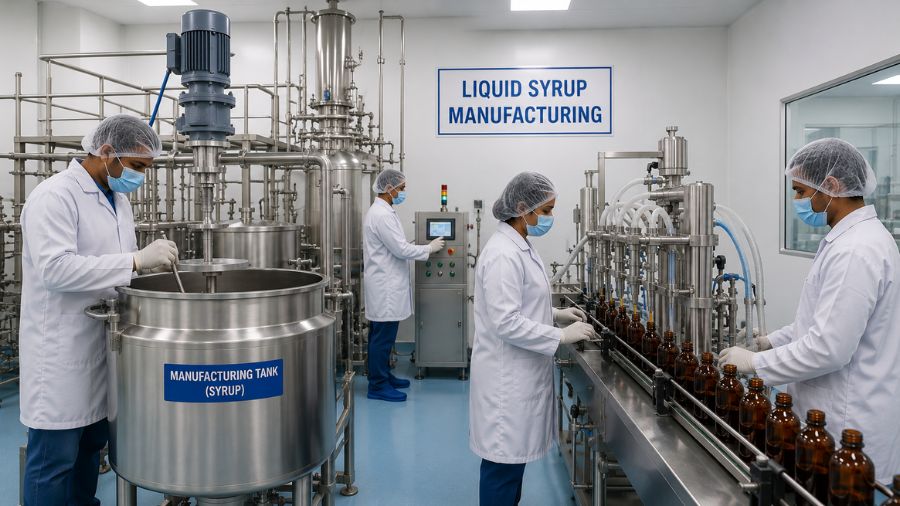
Liquid syrup manufacturing is a process of producing aqueous oral medications or water-based liquid drugs. The types of liquid solutions include cough syrups, antacids, and health tonics. This process involves well-controlled mixing of purified water, sweeteners, Active Pharmaceutical Ingredients (APIs), and excipients to maintain high standards and effectiveness in each batch.
In addition, every batch has to undergo a strict Quality Control (QC) and testing process, including IPCs, finished products testing, and more, to ensure safety and regulatory compliance.



Liquid Syrup Manufacturing: Quality Control Standards
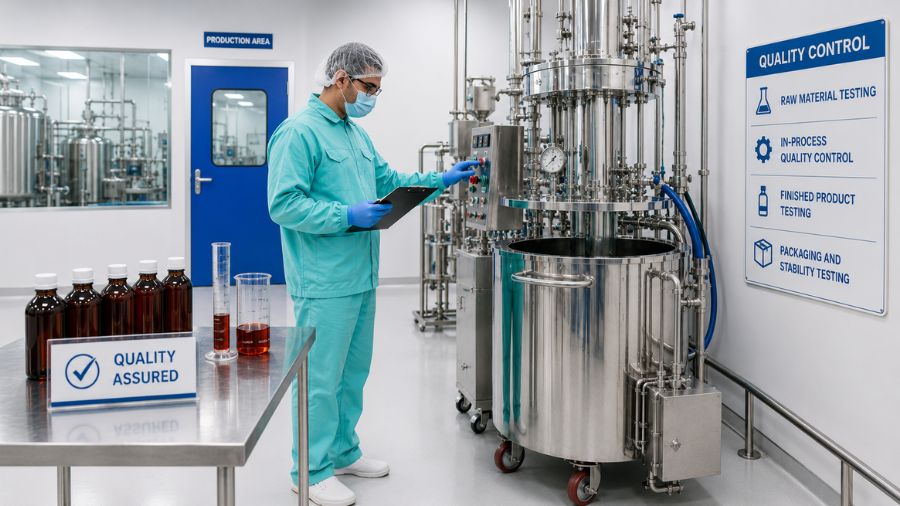
The primary Quality Control (QC) parameters and manufacturing standards that are involved in the liquid syrup manufacturing process include:
1. Raw Material Testing
Prior to the manufacturing process, the raw materials that have been collected must be sampled and verified as per the specific approved requirements.
- Active Pharmaceutical Ingredients (APIs): The third party pharmaceutical manufacturer uses the HPLC (High-Performance Liquid Chromatography) process to test identity, purity, moisture content, and assay of the APIs.
- Excipients: Due to the frequent use of excipients like sweeteners, flavoring agents, and preservatives, it is necessary to test them for microbial limit and heavy metal content to ensure safety.
- Purified Water: The vehicle that is used in the liquid syrup manufacturing process must comply with pharmacopeia guidelines for conductivity, Total Organic Carbon (TOC), and microbial limits.
2. In-Process Quality Control (IPQC)
In liquid syrup manufacturing in India, the In-Person Quality Control (IPQC) is a system for monitoring, sampling, and testing materials and products.
It mandates a detailed description of the manufacturing process in the Batch Manufacturing Record (BMR), which acts as proof that each batch was produced in accordance with the specific approved procedures.
- Temperature and Agitation: To prevent the medicines from severe physical and chemical defects, such as unwanted crystallization, viscosity drops, unintended thermal inversion, and caramelization, the sugar melting and manufacturing vessels are put under careful monitoring to ensure complete dissolution.
- Organoleptic Evaluation: Organoleptic evaluation is a widely adopted process in the liquid syrup manufacturing in India. It uses appearance, color, odor, and clarity to ensure the quality standards of the medicine.
- pH Level Measurement: Then, the pH levels are measured to assess stability and solubility. In this process, well-qualified technicians utilize pH meters to measure the pH levels of batches to maintain the required buffer range.
- Viscosity Evaluation: Viscosity evaluation is an important process in the liquid drugs manufacturing process. By using rotational or capillary viscometers, the technicians measures it stability and pourability.
- Filtration: A filtration process is then conducted to remove any undissolved particulate matter in the liquid syrup.
- Brix Value: To check the sugar concentration levels in the syrup formulation, the refractive index, or polarimetry framework is utilized.
3. Finished Product Testing
In the last step, the batches are sent to laboratories for careful, well-managed testing before they are approved and released in the market for consumption.
- Assay: A mandated laboratory procedure to measure the concentration of Active Pharmaceutical Ingredients (APIs) in the liquid syrup manufacturing process.
- Specific Gravity and Density: A specialized device called a pycnometer is used in this step to ensure batch consistency and proper concentration of sugar levels for correct dosage assessment.
- Microbial Limit Testing (MLT): Liquid syrups are non-sterile oral dosage forms that require special microbiological quality standards. That is why lab specialists and technicians use the Microbial Testing to prevent the proliferation of pathogenic microorganisms throughout the shelf life of the medicine.
4. Packaging and Stability Testing
- Packaging Compatibility: The syrup formulations are packed in high-quality, specialized materials to protect the Active Pharmaceutical Ingredients (APIs) from being exposed to photon particles and UV radiation from the sun, which can cause photodegradation.
- Stability Studies: Under the Central Drugs Standard Control Organisation (CDSCO) and WHO-GMP norms, the medicine manufacturing companies in India follow mandatory procedures to assess the stability of liquid syrups.
- Accelerated Stability Testing: It is conducted for 6 months to predict the stability of the medicine in extreme conditions of 40°C ± 2°C and 75% RH ± 5% RH.
- Long-Term and Real-Time Testing: It is essential to predict and assess the shelf life of the syrup as per Indian climatic conditions. This testing is conducted at 30°C ± 2°C and 75% RH ± 5% RH for straight 12 to 24 months.
Why Choose Medella Softgel for Third Party Liquid Syrup Manufacturing?
Choosing a third party pharma manufacturing company in India is important for product quality, market compliance, and brand reputation. As a reliable partner like Medella Softgel that complies with the WHO-GMP regulations and implements strict Quality Assurance (QA) and Quality Control (QC) frameworks in the manufacturing, it helps you position your brand as a trusted name in the market.
Below is why you must choose Medella Softgel:
- Use of advanced and modern liquid processing infrastructure.
- Implementation of Quality Assurance (QA) and Quality Control (QC) systems.
- Strict adherence to the CDSCO and WHO-GMP guidelines and ISO standards.
- Formulation development to timely logistical support.
- Flexible manufacturing to meet the seasonal requirements of the companies.
- Well-qualified team of researchers, scientists, technicians, and healthcare professionals.
- Custom labelling and safe packaging of the medicines.
- Operates with the relevant pharma manufacturing license and regulatory permits.
Conclusion
Liquid syrup manufacturing is a process of producing water-based liquid drugs in which the pure water, sweeteners, Active Pharmaceutical Ingredients, and excipients are mixed, making up an effective and safe medical solution for patients. This process requires strict compliance with the WHO-GMP guidelines and includes a well-regulated Quality Control (QC) system to ensure the safety and tolerance.
With a strong commitment to improving global healthcare, we, Medella Softgel, stand as your reliable partner if you are searching for a third party pharmaceutical manufacturer in India. We are ISO, WHO, and GMP certified and maintain strict adherence to Quality Assurance (QA) and Quality Control (QC) guidelines to ensure each pharma product, including liquid syrup batches, is safe, effective, and complies with the regulatory standards.
Therefore, you can trust us and connect with us to outsource your pharma products production to a highly trusted pharma manufacturer.
Also Read: Third-Party vs Contract vs Pharma Manufacturing Loan License Explained