
GST on Pharma Products: Quick Guide for Manufacturers
Pharma manufacturers in India operate under specified GST rate structures. For specific life-saving drugs, it is 0% or NIL; for general medical formulations, it is 5%; and for raw materials and APIs, it is charged at 18%.
Held on September 3, 2025, the 56th GST Council Meeting introduced some notable revisions to the pharmaceutical tax rates. For pharmaceutical manufacturers, it changed everything, from purchasing raw materials to the sale of finished medicines, followed by the GST 2.0 reforms that were implemented on September 22, 2025. Thus, knowing the applicable structure of GST on pharma products, exemptions, and HSN classifications becomes important for manufacturers so they can effectively manage their tax credits and calculate tax accurately.
GST Rates Applicable to Pharma Products
GST on pharma products falls into three main tax slabs after the removal of the 12% slab in the GST 2.0 reforms implemented on September 22, 2025.
Here are the current GST rates for medicines:
1. 0% (Nil or Fully Exempt)
Zero percent (Nil) GST rates apply to specific life-saving drugs. They include 36 specific drugs, as listed in the applicable GST notification, that are used for treating cancer, HIV, rare diseases, or severe chronic medical conditions.
Under this drugs GST rate category, some of the fully exempt medicines include:
- Alectinib (Lung cancer)
- Daratumumab and Darzalex (Multiple myeloma)
- Atezolizumab and Tecentriq (Various cancers)
- Evrysdi (Spinal muscular atrophy)
- Hemlibra (Hemophilia A)
- Leqvio (Cholesterol-lowering)
- Repatha (Cholesterol-lowering)
- Zolgensma (Spinal muscular atrophy)
- Agalsidase Beta, Imiglucerase, and Eptacog alfa.



- 5% (Merit Rate)
A 5% GST rate on pharmaceutical products, including all generally prescribed and over-the-counter (OTC) medicines, is applied.
Categories of 5% GST on pharma products include:
- General Pharma Products: Most finished medicines, tablets, capsules, syrups, injectables, AYUSH, Allopathic, Ayurvedic, Unani, and Homeopathic medicines.
- Medical Devices and Equipment: Below is a table consisting of the medical devices and equipment with their HSN codes, on which 5% GST is applied in India.
| Category | Medical Device and Equipment | HSN Code |
| Surgical and Clinical Instruments | Syringes and needles | 9018 |
| Surgical instruments and appliances | 9018 | |
| Surgical rubber and medical examination gloves | 4015 | |
| Diagnostic and Imaging Equipment | Diagnostic kits and reagents | 3822 |
| ECG machines and electro-diagnostic apparatus | 9018 | |
| X-ray equipment | 9022 | |
| CT scan equipment | 9022 | |
| MRI equipment | 9018 | |
| Other medical radiology equipment covered under HSN 9022 | 9022 | |
| Monitoring and Assistive Devices | Medical thermometers | 9025 |
| Pulse oximeters and similar medical monitoring devices | 9018 | |
| Glucometers and test strips | 9027 | |
| Wheelchairs | 8713 | |
| Crutches and orthopaedic appliances | 9021 | |
| Walking frames and other orthopaedic appliances | 9021 | |
| Artificial limbs and artificial parts of the body | 9021 | |
| Artificial kidney and dialysis-related specified equipment | 9018 and specified entries | |
| Consumables and Medical Supplies | Medical-grade oxygen | 2804 |
| Bandages and gauze covered by HSN 3005 | 3005 | |
| Corrective spectacles | 9004 | |
| Corrective goggles | 9004 |
- 18% (Standard Rate)
A standard 18% GST is applied to specific products, including:
- Nicotine Polacrilex Gum
- Cosmetic Healthcare
- Hospital Furniture
How Does GST Impact Pharma Manufacturers?
The rates of GST on pharma products impact third party pharma manufacturing companies in many ways. On the one hand, it simplifies the indirect tax and cuts logistics costs; however, on the other hand, it introduces some challenges regarding compliance and ITC accumulation as well.
Here are some of the positive effects of GST rates:
- Unified Taxation: No multi-layered taxation, such as excise duty, VAT, and CST; each one is unified as one Goods and Services Tax (GST).
- Optimized Supply Chains: Manufacturers do not have to set up warehouses in multiple states to avoid 2% interstate Central Sales Tax (CST). After the arrival of GST, they can turn small storage units into large warehouses, helping them save money, stop border delays, and manage pharma stocks better.
- Reduced Logistics Costs: Due to the removal of the 2% border tax, businesses do not have to face extra charges spent on logistics and transport.
- Lower Job-Work Rates: Job-work services in relation to the manufacture of pharmaceutical products attract GST at 5% from 22 September 2025, subject to the applicable classification and conditions.
Challenges manufacturers have to face:
- Inverted Duty Structure: Many raw materials and APIs are taxed at 18%, whereas the finished goods are taxed at 5%. This creates a constant surplus of Input Tax Credit (ITC), which means they pay more on raw materials and sell final products at comparatively lower rates.
- Free Samples and Disguised Supplies: Medicine manufacturing companies in India lose tax credits and have to face unrecoverable expenses on distributing free samples to doctors, bonus items, and accepting expired goods.
- Complex Compliance: Pharma manufacturers, along with distributors, have to maintain compliance with strict multi-state return filings and vendor invoice matching.
Practical GST Checklist for Pharmaceutical Manufacturers
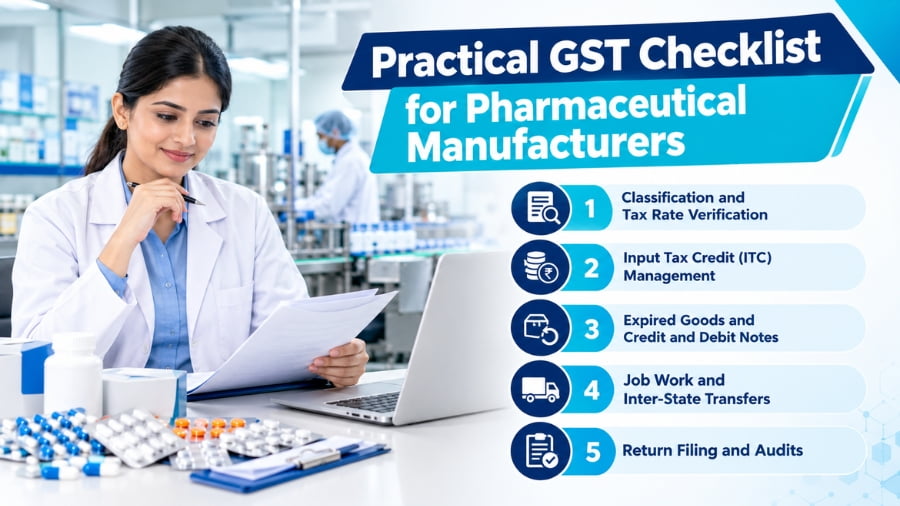
A practical checklist of GST on pharmaceutical products for manufacturers includes correct classification of drug tax slabs, regular Input Tax Credit (ITC) management, and proper handling of expired goods and job work.
Here is a complete breakdown:
- Classification and Tax Rate Verification
Make sure that the relevant HSN codes are accurately mentioned on all formulations, APIs (Active Pharmaceutical Ingredients), and other pharma goods.
- Input Tax Credit (ITC) Management
Where taxable and exempt supplies are made, ITC attributable to exempt supplies and the applicable portion of common ITC must be reversed in accordance with section 17(2) and the applicable GST on pharma products rules.
- Expired Goods and Credit and Debit Notes
For time-expired medicines, follow the applicable CBIC procedure. Depending on the results, the return may be treated as a fresh supply by the returning registered person or handled through a credit-note mechanism under section 34.
- Job Work and Inter-State Transfers
- Always maintain track records for raw materials and APIs.
- Use correct e-way bills to monitor the stock transfers across different states between manufacturing units.
- Make sure that the e-way bills are active and match the vehicle details.
- Return Filing and Audits
- File GSTR-1 and GSTR-3B to maintain compliance.
- File GSTR-9 where applicable, and furnish GSTR-9C where the applicable turnover threshold is exceeded, according to the due date.
Conclusion
Pharma manufacturers need to understand the GST rates on medicines, so they can manage pricing of pharma products, Input Tax Credit (ITC), and regulatory compliance effectively. In addition, by maintaining compliance with the applicable product classification, ITC, invoicing, and GST return filing, you can manage unnecessary tax costs and stay compliant.
If you want to outsource medicine manufacturing, you can connect with Medella Softgel. As a third-party and contract pharma manufacturing company in india, we offer pharma product manufacturing solutions to businesses across India. We are WHO-GMP and ISO certified, with a team of professionals dedicated to offering high-quality services. Thus, contact us and get pharma manufacturing.
Also Read: Loan License in Pharma: Meaning, Process, Benefits & Requirements