
Pharma Manufacturing Process In India: Complete Guide
The pharmaceutical manufacturing process in India is a regulated two-stage process that converts raw materials into safe and consumable medicines. It begins with API synthesis, then secondary manufacturing, where API is converted into usable forms, like tablets, liquids, or injectables.
India, in terms of volume, is the third-largest producer of medicines in the world. This is possible due to tech integration and best practices used by pharma companies. Behind every highly effective API, formulation, or generic medicine, they follow a meticulous and highly regulated process, from raw material to consumable drugs. While maintaining quality production standards and regulatory compliance, the pharmaceutical manufacturing process in India includes primary production, packaging, and distribution.
Pharmaceutical Manufacturing Process in India
Here is the step-by-step pharmaceutical manufacturing process in India:
1. Primary Manufacturing (API Production)
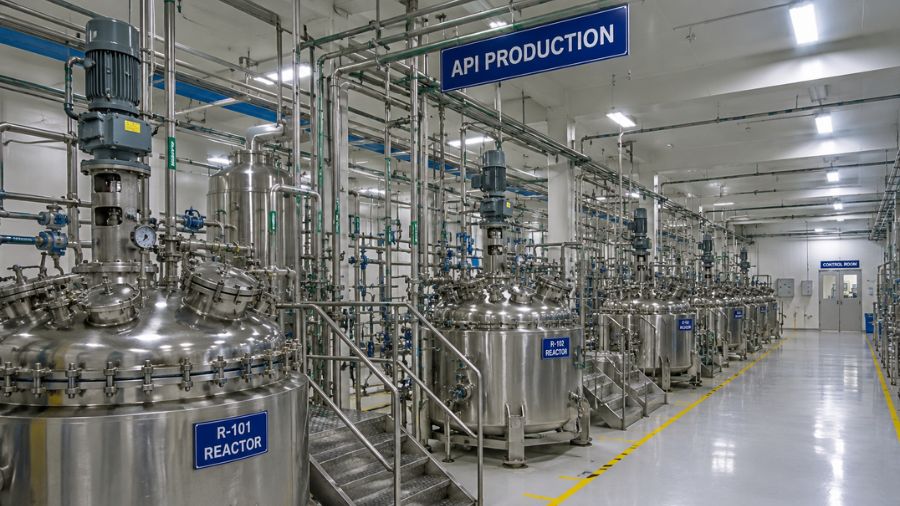
Primary manufacturing, which is also known as API production, is the first stage of the pharmaceutical manufacturing process. In this process, the biologically active compounds are synthesized or extracted from the raw materials. It is a crucial step to perform before the medicine is combined with the inactive excipients in the final dosage formulation.
The production methods of APIs include:
- Chemical Synthesis: API molecular construction through organic and inorganic chemical reactions.
- Fermentation and Cell Culture: Using microorganisms, like bacteria or yeast, to grow active compounds.
- Extraction: Isolation and purification of active compounds from animal or natural sources.
The process of API production:
- Raw Material Sourcing
- Synthesis or Fermentation
- Separation and Purification
- Crystallization
- Drying and Milling



2. Secondary Manufacturing (Drug Product Formulation)
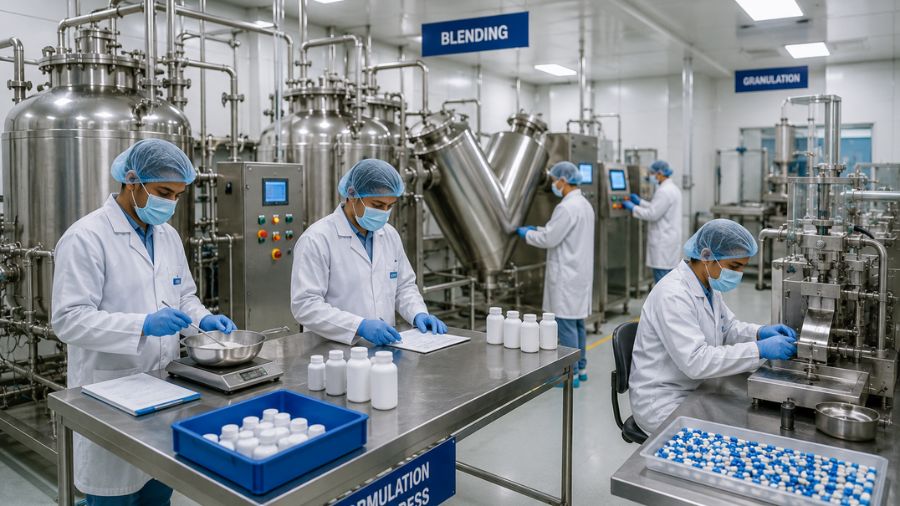
The second stage of the medicine or drug manufacturing process in India consists of a process where the inactive excipients are combined with the APIs to create stable, effective, and safe medicine formulations for patient use. These formulations are accessible in the form of tablets, capsules, liquids, and injectables.
The process of secondary manufacturing:
- Preformulation and Excipient Selection
Before the medicines are ready for mass production, the developers conduct the preformulation and excipient selection process, in which they characterize APIs to determine their physical and chemical properties. The properties include their solubility, particle size, and stability.
Then, they select suitable excipients to improve bioavailability, create desired release profiles, and ensure medicine stability.
- Formulation Steps
Medicine formulations, such as Oral Solid Dosage (OSD), sterile liquids, and injectables, require different formulation steps in the drug manufacturing process in India.
For Oral Solid Dosage (OSD):
- Blending: Homogenization of APIs and inactive excipients
- Granulation: Conversion of fine powder into uniform granules
- Drying and Milling: Moisture removal and granule uniformity
- Compression and Encapsulation: Compressing granules into tablets or filling into capsules
- Coating: Film application for drug protection.
For injectables and sterile liquids:
- Compounding: Dissolving the APIs and cryoprotectants into a liquid vehicle
- Sterile Filtration: Removal of microbial containments
- Filling: Under controlled conditions, the medicines are filled into vials, ampoules, or syringes.
3. Quality Assurance and Quality Control (QA and QC)
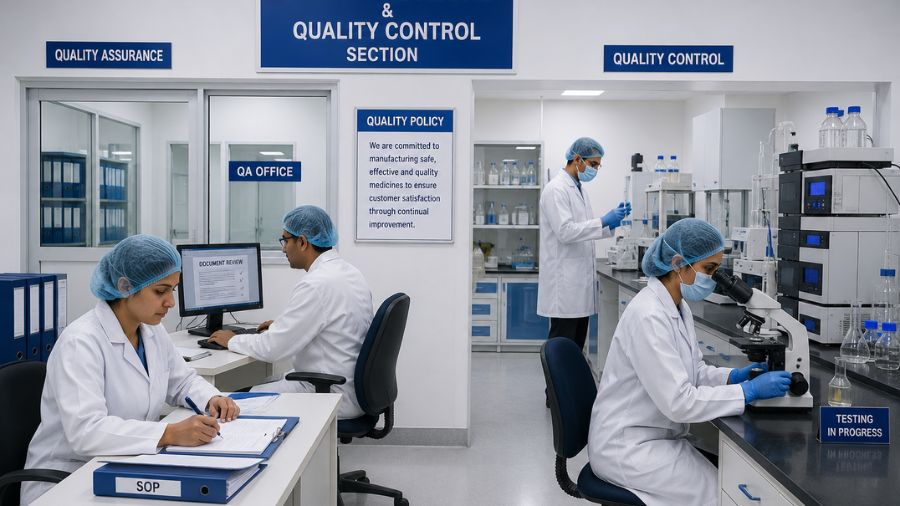
Quality Assurance and Quality Control (QA and QC) are the cornerstone of the pharma manufacturing process in India.
In the pharma manufacturing process in India, after secondary manufacturing, Quality Assurance and pharma manufacturing Quality Control (QA and QC) play the role of a cornerstone, as they are important to ensure drug safety, efficacy, and compliance with the regulatory standards.
Quality Assurance (QA)
- SOP Management: Drafting and enforcement of the Standard Operating Procedures.
- CAPA: Implementation of Corrective and Preventive Actions (CAPA) to eliminate the root causes of the quality issues.
- Validation and Qualification: Utilization of IQ, OQ, and PQ protocols to ensure facility and equipment safety and quality.
- Vendor Audits: Evaluation of the supplier or the source of the raw material to maintain safety.
Quality Control (QC)
- Raw Material Testing: Raw material testing is necessary to identify the identity, purity, and composition of the APIs and excipients before production.
- In-Process Controls (IPQC): Monitoring product parameters such as tablet weight, pH, and temperature to maintain regulatory and quality standards.
- Finished Product Release: Strict Standard Operating Procedures (SOPs) for Batch Manufacturing Record (BMR), Packaging Records (BPR), Certificate of Analysis (CoA), and others before QA personnel release the batch for consumer use.
- Stability Studies: A structured process of analyzing the effects of changes in temperature, humidity, and light on quality, safety, and efficacy.
4. Packaging and Distribution
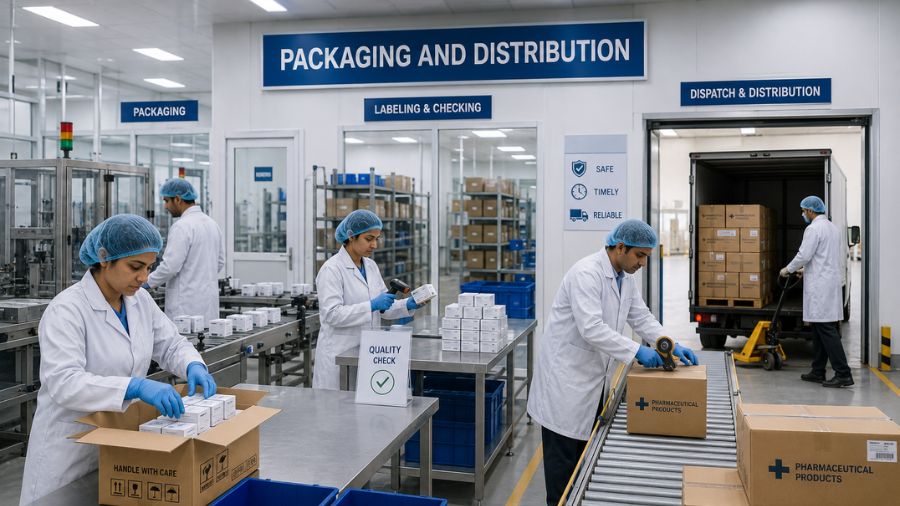
After the medicine passes the complex stages of QA and QC, they are cleared for packaging into bottles, blister packs, or vials with serialization, including manufacturing dates, chemical composition, and expiry date, to meet global traceability standards.
Compliance and Regulatory Requirements
The third party pharma manufacturing companies in India operate under the Drugs & Cosmetics Act, 1940, and are enforced by the Central Drugs Standard Control Organization (CDSCO). This act mandates regulatory compliance for drug safety, quality standards, overseeing drug clearances, and clinical trials for every pharma manufacturer.
- Schedule M (Good Manufacturing Practice (cGMP)): Enforces strict guidelines, mandated to be followed by every third party pharmaceutical manufacturer in India to maintain hygiene standards in the facility, plant, and equipment.
- Central Drugs Standard Control Organization (CDSCO): Oversees drug approvals, import licensing, quality control, and licensing and ensures quality of medicines that are manufactured, imported, and distributed nationwide.
Conslusion
The pharma manufacturing process in India is highly regulated and complex. It consists of multi-stage procedures from primary to secondary production with structured and mandatory steps to meet global standards of medicine quality, efficacy, and regulatory compliance for safe consumer use.
Medella Softgel stands as a trusted and reliable third-party pharma manufacturing company in India. With extensive quality control and expertise, we specialize in manufacturing safe and cost-effective pharmaceutical solutions. Our manufacturing plants are WHO and GMP certified to meet international quality standards and safety assurance.
Also Read: Esomeprazole Magnesium – Uses, Benefits, Dosage & Side Effects Guide